
When Connection Becomes Performance
Why do we sometimes feel the need to earn acceptance? An exploration of learned beliefs, attachment, emotional boundaries, and the freedom to remain connected to ourselves.
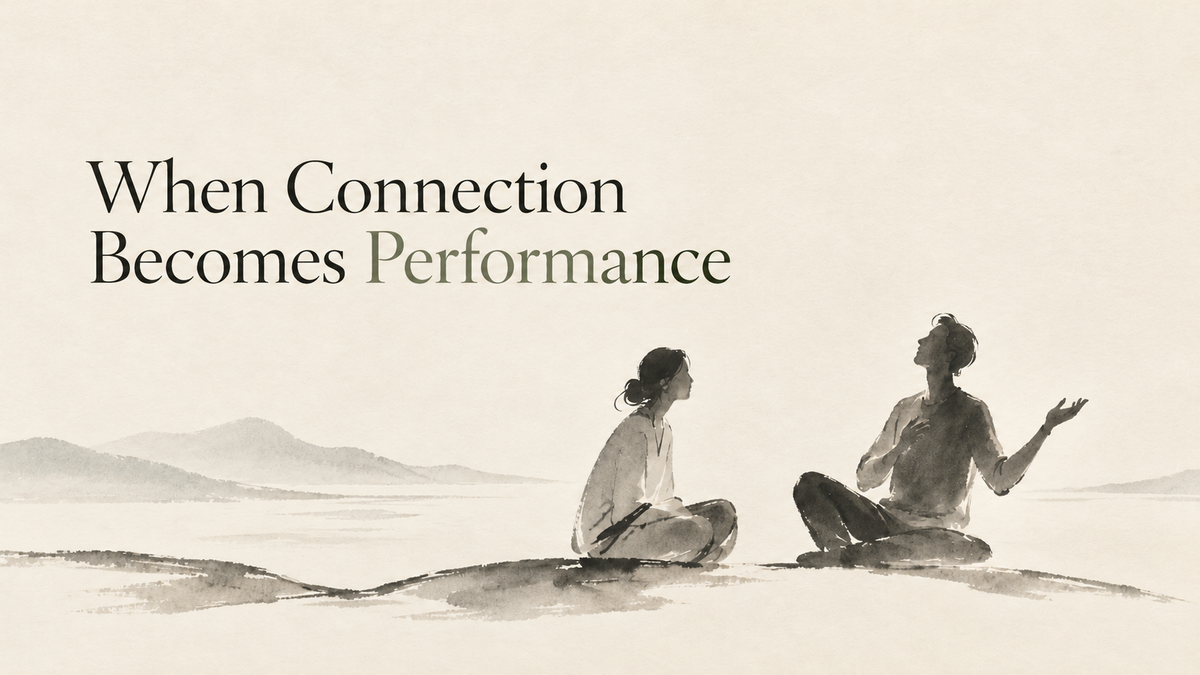
How the search for acceptance shapes our relationships, and how awareness helps us reconnect with ourselves.
The search for connection
Sometimes we walk into a conversation already searching for the right answer. We notice another person's expression, adjust our words, and wonder whether we have disappointed them. A neutral response may even activate the familiar impulse to try harder.
From the outside, this may look like kindness, conscientiousness, or the wish to get along. Internally, it can involve a tiring question: What do I need to be for this connection to remain safe?
There are many reasons people develop this habit. One possibility is that adapting to the expectations of others once helped preserve closeness and belonging.
How protective strategies can develop
Children depend on caregivers and other important adults. They learn about themselves not only through what they are told, but also through how their feelings, needs, accomplishments, and disagreements are received.
When a child repeatedly experiences approval as closely linked to performance or compliance, they may begin paying particular attention to others' expectations. This is an adaptation, not a character defect—and it is not a universal consequence of demanding or achievement-oriented parenting.
Acceptance sometimes feels easier when I meet expectations.
Staying connected may feel more important than expressing my own needs.
I anticipate, accommodate, achieve, and monitor others' reactions.
I may continue searching for reassurance while learning to recognize the freedom available in present relationships.
Each life has its own context, and this sequence offers one possible framework for exploration.
The invisible power of learned beliefs
A person may consciously believe, “My needs deserve respect,” and still feel an immediate need to apologise when someone seems disappointed. The conscious understanding and the automatic response can coexist.
In psychology, core beliefs are broad assumptions about ourselves and the world, while automatic thoughts are interpretations that can arise rapidly in a particular situation. Attachment theory also describes internal working models: learned expectations about closeness, responsiveness, and our place in relationships. These ideas overlap, but they are not identical, and none offers a complete explanation of a person's history.
When an expectation has been rehearsed over time, it may influence where our attention goes, how we interpret uncertainty, and what we feel urged to do. One possible cycle looks like this:
Understanding and measuring learned beliefs
Researchers use questionnaires, interviews, behavioural tasks, and other methods to study constructs such as attachment, self-criticism, and automatic associations. Each method measures a particular aspect of experience and has limitations. There is no single score that can reliably reveal how powerful one unconscious belief is, or prove exactly when it began.
For everyday self-inquiry, observing a recurring pattern with curiosity may be more useful than assigning it a number.
Emotional enmeshment and the space to be separate
Emotional enmeshment describes relationships in which emotional boundaries and individual autonomy become difficult to maintain. A person may feel unusually responsible for someone else's emotions or struggle to know where another person's wishes end and their own begin.
Closeness can include warmth, interdependence, loyalty, affection, and respect for individuality. The question is whether each person has room to have a distinct inner life: different preferences, feelings, opinions, and boundaries.
In adult relationships, the wish for connection can sometimes become intertwined with the fear of disappointing someone. A moment of distance may then feel less like an ordinary relational experience and more like evidence of personal failure.
Meeting our inner responses with compassion
Many people recognize a conflict between tenderness and an impatient internal voice: one part feels sad, frightened, or in need of reassurance; another urges them to move on, be productive, or stop feeling so much.
We can meet each response with curiosity and consider what it may be trying to accomplish. The harsh voice may have become associated with maintaining control, avoiding rejection, or keeping life moving. Recognizing a protective purpose can open space for a more compassionate inner response.
Self-compassion can grow through recognizing our experience with curiosity, allowing new responses to become possible.
Recognizing the pattern in everyday life
One of the most useful opportunities for learning can occur in ordinary interactions. We might notice ourselves rehearsing an answer, searching for approval, or changing a preference before anyone has asked us to.
That moment offers a choice: continue automatically, or become curious about what we are experiencing. The value lies in noticing the pattern as it unfolds and discovering greater freedom in our response.
Three gentle invitations
- Notice when you begin monitoring another person's approval.
- Pay attention to what happens in your body before rushing to explain or correct yourself.
- Experiment, when it feels safe, with expressing a small, genuine preference.
Recognizing familiar beliefs
Choose a recent, manageable moment when you felt uncertain about another person's reaction. You can simply read the prompts, make notes, or leave the exercise for another time.
Describe what you observed before adding an interpretation.
Notice the words or expectations that appeared.
Perhaps tension, warmth, changed breathing, restlessness—or nothing especially noticeable.
Please, explain, seek reassurance, withdraw, apologise, or something else?
From knowing to living
Understanding a pattern intellectually can be meaningful. Embodied awareness and repeated experiences can deepen that understanding. Learning to trust our experience may grow through small, repeated moments: recognizing a need, allowing a feeling, choosing a boundary, or discovering that disagreement need not end a relationship.
Our worth remains present across changing conversations and relationships. The possibility worth exploring is simple and profound: Can I remain connected to someone else while also remaining connected to myself?
Further reading and resources
Selected books and educational resources for deeper exploration.
Research and practical exercises for cultivating a supportive inner relationship.
Self-compassion resourcesA perspective on emotional needs, differentiation, and boundaries in family relationships.
About the bookAn overview of approaches to working with thoughts, feelings, and behaviour.
Read the overviewA foundational perspective on how experiences of care and connection can shape expectations about ourselves, others, and the availability of support in relationships.
Attachment and Loss, Volume 1: Attachment